
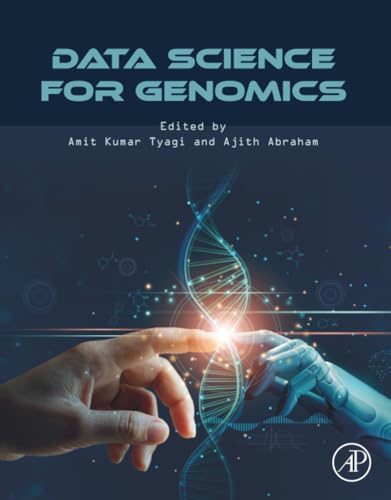
Data science for genomics / edited by Amit Kumar Tyagi, Ajith Abraham
Material type: TextLondon : San Diego : Academic Press, [2023] ©2023Content type:
 - text
- unmediated
- volume
- 9780323983525
- 23 572.86028557 ABR
| Cover image | Item type | Current library | Home library | Collection | Shelving location | Call number | Materials specified | Vol info | URL | Copy number | Status | Notes | Date due | Barcode | Item holds | Item hold queue priority | Course reserves | |
|---|---|---|---|---|---|---|---|---|---|---|---|---|---|---|---|---|---|---|
| Gifted Books | Sai University Library General stacks | 572.86028557 ABR (Browse shelf(Opens below)) | Available | G2963 |
Browsing Sai University Library shelves,Shelving location: General stacks Close shelf browser (Hides shelf browser)

|

|

|

|

|

|

|
||
| 572.8 WEA Molecular biology | 572.809 MAD Rosalind Franklin : the dark lady of DNA | 572.86 WAT The double helix : a personal account of the discovery of the structure of DNA | 572.86028557 ABR Data science for genomics / | 573.2 WOL Race and human evolution | 573.212 COO The gene wars : science, politics, and the human genome | 574.092 BAS Reinventing the future : conversations with the world's leading scientists |
Includes bibliographical references and index
Data Science for Genomics presents the foundational concepts of data science as they pertain to genomics, encompassing the process of inspecting, cleaning, transforming, and modeling data with the goal of discovering useful information, suggesting conclusions and supporting decision-making. Sections cover Data Science, Machine Learning, Deep Learning, data analysis, and visualization techniques. The authors then present the fundamentals of Genomics, Genetics, Transcriptomes and Proteomes as basic concepts of molecular biology, along with DNA and key features of the human genome, as well as the genomes of eukaryotes and prokaryotes. Techniques that are more specifically used for studying genomes are then described in the order in which they are used in a genome project, including methods for constructing genetic and physical maps. DNA sequencing methodology and the strategies used to assemble a contiguous genome sequence and methods for identifying genes in a genome sequence and determining the functions of those genes in the cell. Readers will learn how the information contained in the genome is released and made available to the cell, as well as methods centered on cloning and PCR.
There are no comments on this title.